
I. The Number That Should Be Getting More Attention
A. What the Data Actually Says
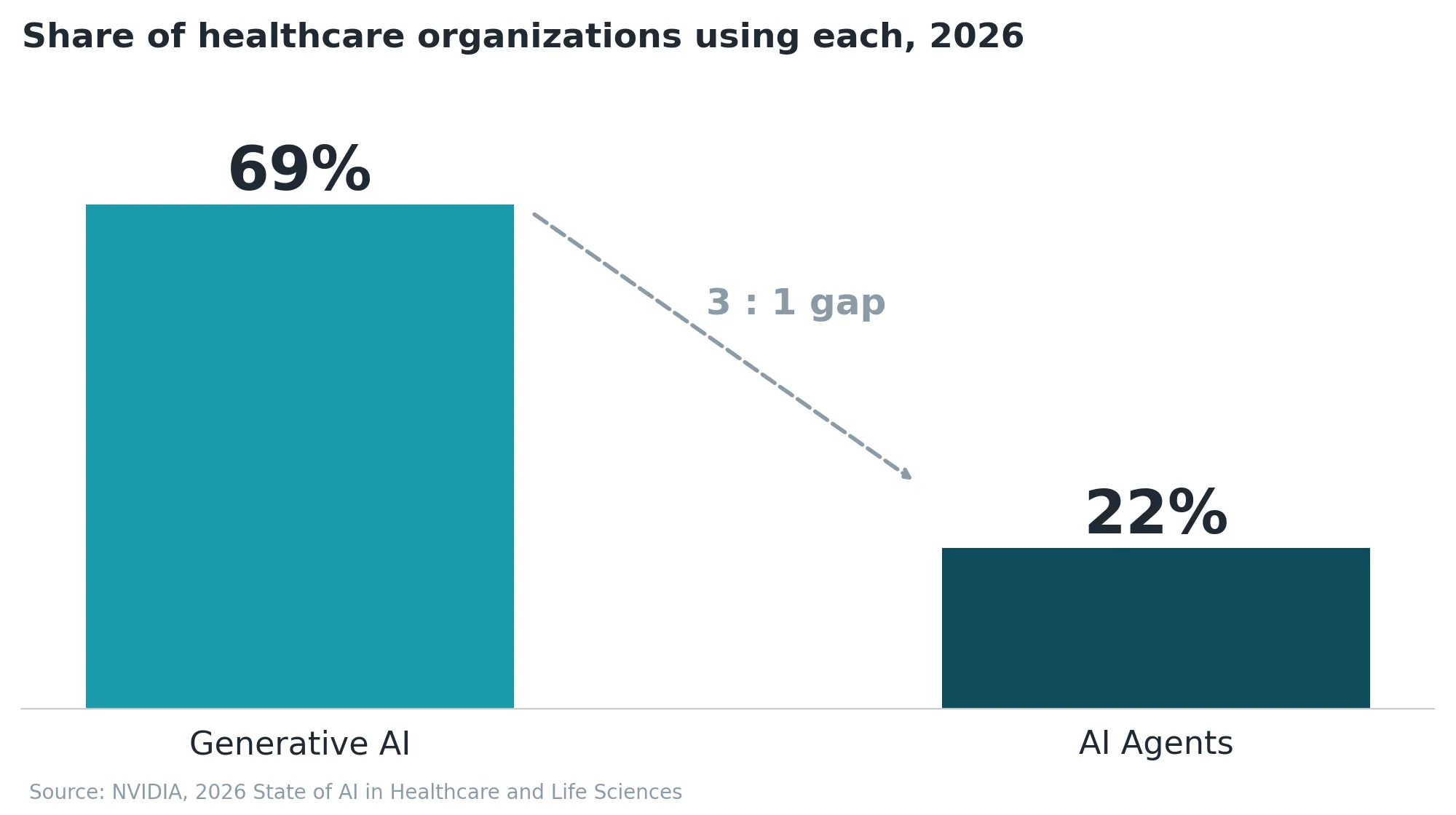
There’s a statistic from NVIDIA’s 2026 State of AI in Healthcare and Life Sciences report that deserves more scrutiny than it’s getting: roughly 69% of healthcare organizations report using generative AI, while only about 22% report using AI agents.
That’s a three-to-one gap between organizations that have adopted AI and organizations that have adopted AI that does anything.
It’s tempting to read this as a maturity curve, agents are newer, so adoption lags, and the number will catch up on its own. That reading is comfortable and mostly wrong. Generative AI went from novelty to standard clinical infrastructure in about two years. Ambient documentation was a pilot at a handful of academic medical centers and is now the most widely deployed AI category in healthcare by a significant margin. Healthcare is clearly capable of adopting AI quickly when the path is clear.
So the question isn’t why agents are slow. It’s what specifically is in the way.
B. Where the Adoption Actually Stalls
Industry analysis through 2026 points consistently at the same set of causes. Agentic adoption remains limited because action-based use cases require deeper system integration, higher access rights, and stricter governance than advisory tools do, which makes them substantially harder to deploy at scale.
Read that list again, because none of those items are model problems:
- Deeper system integration
- Higher access rights
- Stricter governance
These are platform engineering problems. They’re the problems that show up after the demo works, when someone in security asks what happens if the agent is wrong at 2 a.m. on a Saturday. For teams already running AI agents in production, none of this will be a surprise, for everyone else, it’s the whole project.
II. What Actually Changes When AI Acts Instead of Advises
A. The Read/Write Boundary
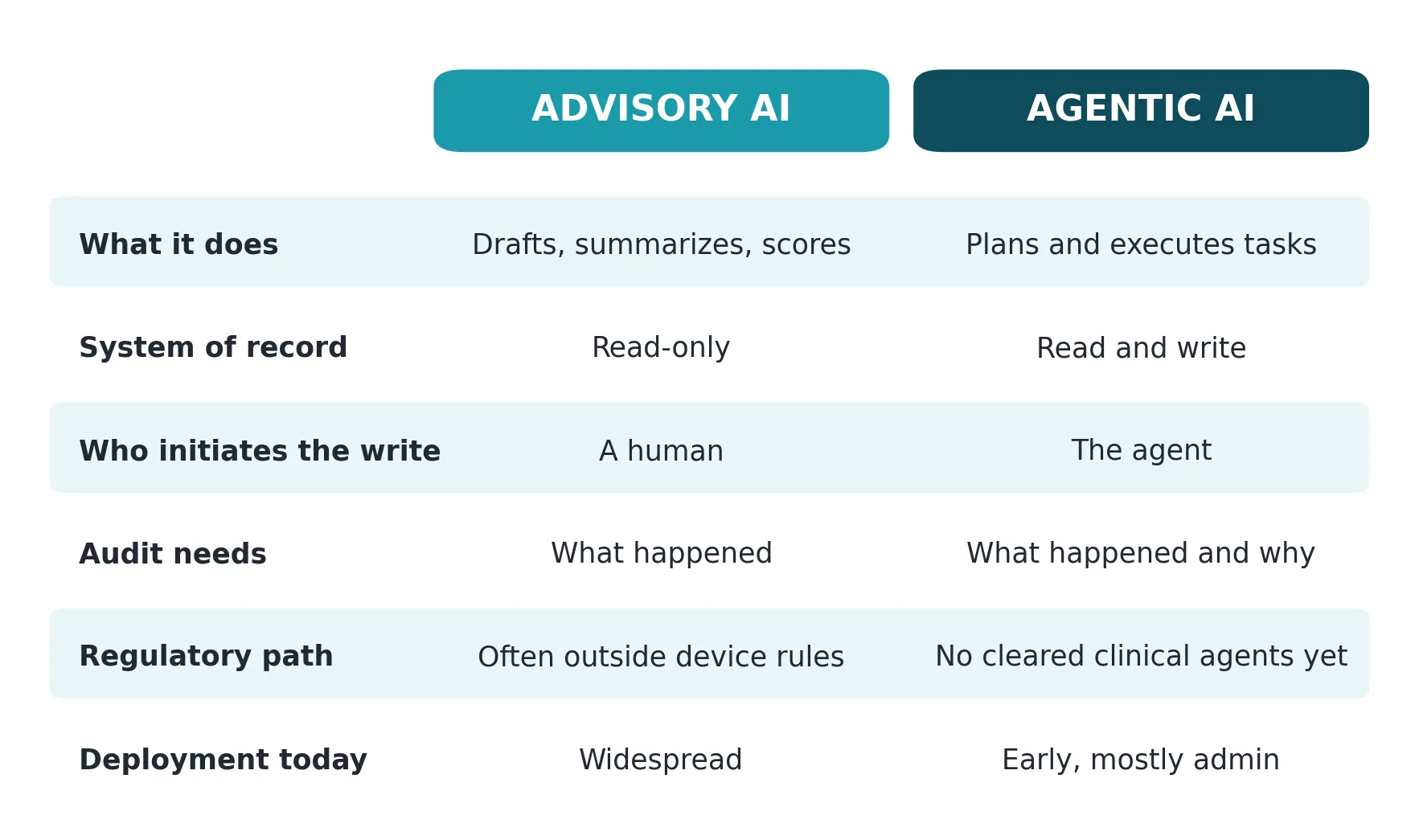
Most healthcare AI in production today is read-only. An ambient scribe listens and produces a draft. A risk model scores a patient and surfaces a number. A summarizer condenses a chart. In every case, a human takes the output and decides what to do with it.
The system of record never changes unless a person changes it.
An agent breaks that pattern. A scheduling agent moves an appointment. A prior-auth agent submits a packet. A care-gap agent sends a notification to a patient. The write happens without a human initiating that specific action, which is precisely what makes agents valuable, and precisely what makes them hard.
Once you cross the read/write boundary, a whole set of questions that never applied to your summarizer suddenly do:
- Attribution: Who performed this action, in the audit log, when the actor was software?
- Authorization: Under whose clinical authority did it happen?
- Reversibility: Can this be undone, and does undoing it leave a clean trail?
- Blast radius: If the agent’s reasoning is wrong, does it affect one patient or a panel of four thousand?
B. The Regulatory Line Nobody Wants to Cross First
The regulatory picture reinforces the same boundary. As of April 2026, the FDA had cleared zero agentic clinical AI systems. ARPA-H’s ADVOCATE program is working to establish the first authorization pathway through a multi-year process for a cardiovascular care agent.
Meanwhile, ambient clinical documentation has scaled across health systems, largely because it documents rather than diagnoses, which usually keeps it outside medical device regulation.
That contrast explains a lot of the 69/22 gap on its own. The advisory tools found a path to deployment that didn’t require anyone to be first through an unmapped regulatory door. Agentic clinical tools haven’t yet. And most organizations, reasonably, would rather not fund the mapping expedition.
The practical takeaway for product teams: the line that matters isn’t AI or no AI. It’s advise or act. Where your feature sits relative to that line determines your compliance surface, your liability exposure, and your time to market far more than your model choice does.
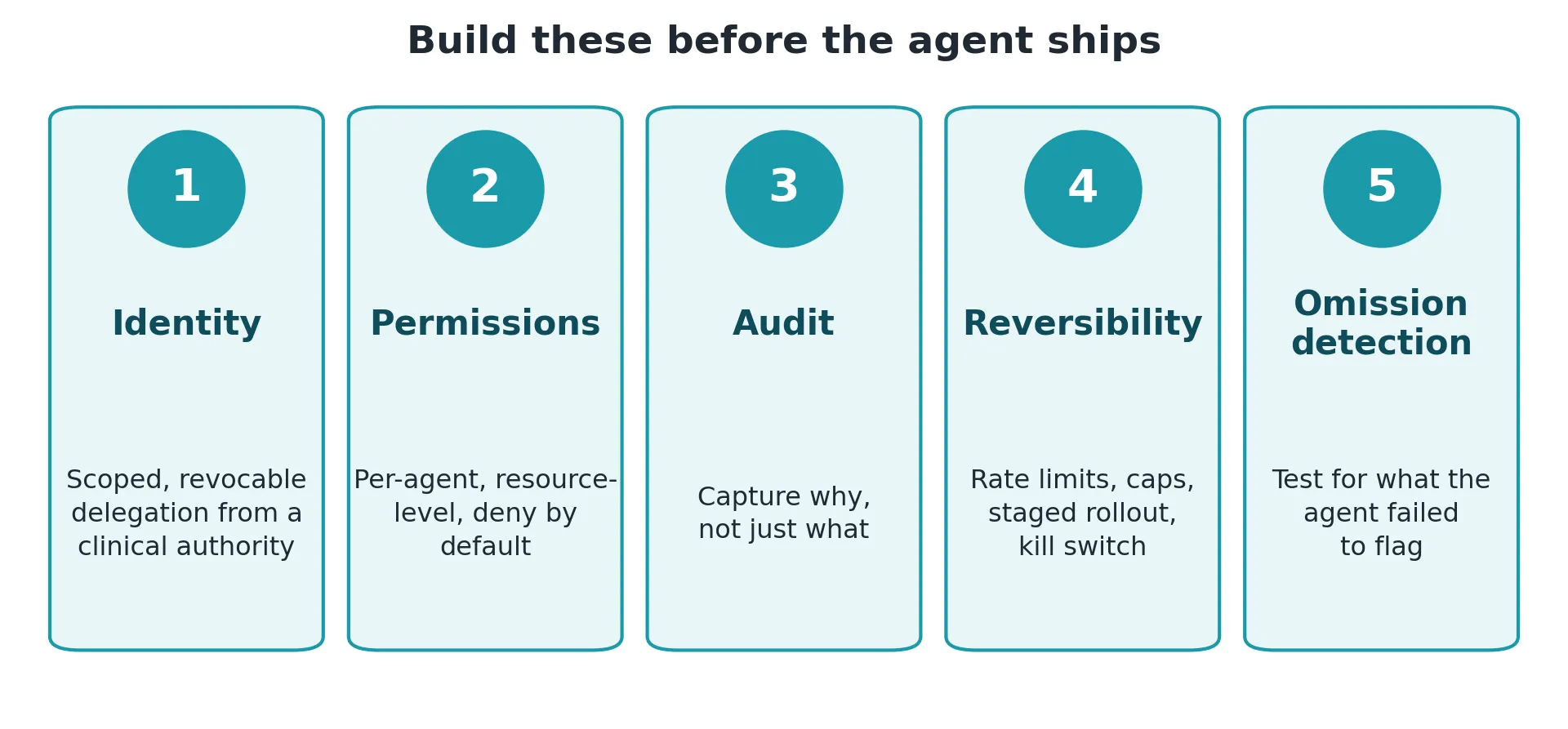
III. The Five Things That Have to Exist Before an Agent Ships
This is the part that rarely makes it into AI strategy decks, because it isn’t strategy. It’s plumbing. But it’s where agent projects actually die.
A. Identity: Your Agent Doesn’t Have a User
Every healthcare system’s access model assumes a human principal. A clinician logs in, their role determines their rights, and their actions are attributed to their identity. That model has decades of regulatory and operational assumptions built on top of it.
An agent doesn’t fit. It isn’t a user, and it isn’t quite a system integration either, it acts on behalf of a clinician, sometimes, for some actions, within limits.
The lazy solution is a service account with broad rights. It works in the pilot and fails the first security review, because now every action the agent takes is attributed to a generic identity with more permissions than any single human in the organization.
What you actually need is a delegation model: the agent operates under a scoped grant from a specific clinical authority, that grant is time-bound and revocable, and the audit trail records both the agent and the human whose authority it acted under. SMART on FHIR’s scoping model gives you a reasonable starting vocabulary here, but it was designed for apps a user launches, extending it to autonomous, long-running agents takes deliberate design.
B. Permissions Scoped to the Resource, Not the System
“The agent has FHIR access” is not a permission model. It’s the absence of one.
A medication adherence agent needs to read MedicationRequest and write Communication. It has no business reading psychiatric notes, and it should be structurally incapable of doing so, not merely instructed not to.
Concretely, this means:
- Per-agent scopes, not per-application: Two agents in the same product get different grants.
- Resource-type and often resource-instance granularity: Read access to this patient’s observations, not the population’s.
- Separate read and write scopes, always: Most agents need far more read than write.
- Deny by default: New capability requires a new grant and a new review.
This is ordinary least-privilege thinking. It just gets skipped constantly, because during development it’s friction and the agent works fine without it.
C. Audit Trails That Reconstruct Reasoning, Not Just Results
Standard audit logging answers what happened. For agents you need to answer why, and you need to answer it months later, potentially to a regulator or an attorney.
That means capturing, for each agent action:
- The inputs the agent had access to at decision time
- The specific model and version that produced the decision
- The intermediate steps, if the agent chained multiple calls
- The policy or guardrail evaluations that permitted the action
- The human approval, where one was required, including who and when
This is meaningfully more data than most logging pipelines are built for, and it needs the same retention and access controls as PHI, because much of it is PHI. Retrofitting this later is painful. Build it into the first agent.
D. Reversibility and Containment
Before an agent goes live, someone should be able to answer two questions in concrete terms:
- If this action is wrong, what’s the procedure to reverse it?
- If the agent is systematically wrong, how many records does it touch before anyone notices?
Question two is the one that gets skipped. A rate limit is a safety control. A daily cap on autonomous actions is a safety control. A staged rollout that starts at one clinic is a safety control. These aren’t performance optimizations, they’re what keeps a bad deployment from becoming a reportable event.
E. Detection for Errors of Omission
This is the least intuitive requirement, and possibly the most important.
Most AI quality assurance is built to catch the model saying something wrong, hallucinations, fabricated citations, incorrect codes. But a 2025 evaluation of clinical agent behavior found that over 80% of severe errors were failures to flag danger, rather than incorrect statements. The system’s mistake was silence.
Almost no standard QA pipeline detects silence. You can’t diff a missing alert against an expected output if your test set only contains cases where something was said.
Building for this means constructing evaluation sets specifically around cases where the correct behavior is escalation, the patient who should have been flagged, the interaction that should have blocked, the result that should have paged someone. Then you measure how often the agent stayed quiet when it shouldn’t have.
There’s a related human factor worth designing against: automation bias. When an agent produces a fluent, well-structured draft, reviewers approve it faster and scrutinize it less. A human-in-the-loop step that becomes a reflexive click is not a safety control, it’s a liability transfer with extra steps. If your workflow depends on genuine review, the interface has to make review genuinely necessary.
PakarPBN
A Private Blog Network (PBN) is a collection of websites that are controlled by a single individual or organization and used primarily to build backlinks to a “money site” in order to influence its ranking in search engines such as Google. The core idea behind a PBN is based on the importance of backlinks in Google’s ranking algorithm. Since Google views backlinks as signals of authority and trust, some website owners attempt to artificially create these signals through a controlled network of sites.
In a typical PBN setup, the owner acquires expired or aged domains that already have existing authority, backlinks, and history. These domains are rebuilt with new content and hosted separately, often using different IP addresses, hosting providers, themes, and ownership details to make them appear unrelated. Within the content published on these sites, links are strategically placed that point to the main website the owner wants to rank higher. By doing this, the owner attempts to pass link equity (also known as “link juice”) from the PBN sites to the target website.
The purpose of a PBN is to give the impression that the target website is naturally earning links from multiple independent sources. If done effectively, this can temporarily improve keyword rankings, increase organic visibility, and drive more traffic from search results.
